The Prime Minister’s Employment Generation Programme (PMEGP) is an important initiative by the Government of India aimed at encouraging entrepreneurship and reducing unemployment. It is especially designed to support people who want to start their own small businesses but lack sufficient financial resources. The scheme operates under the guidance of the Khadi and Village Industries Commission, which works along with banks and local authorities to ensure smooth implementation.
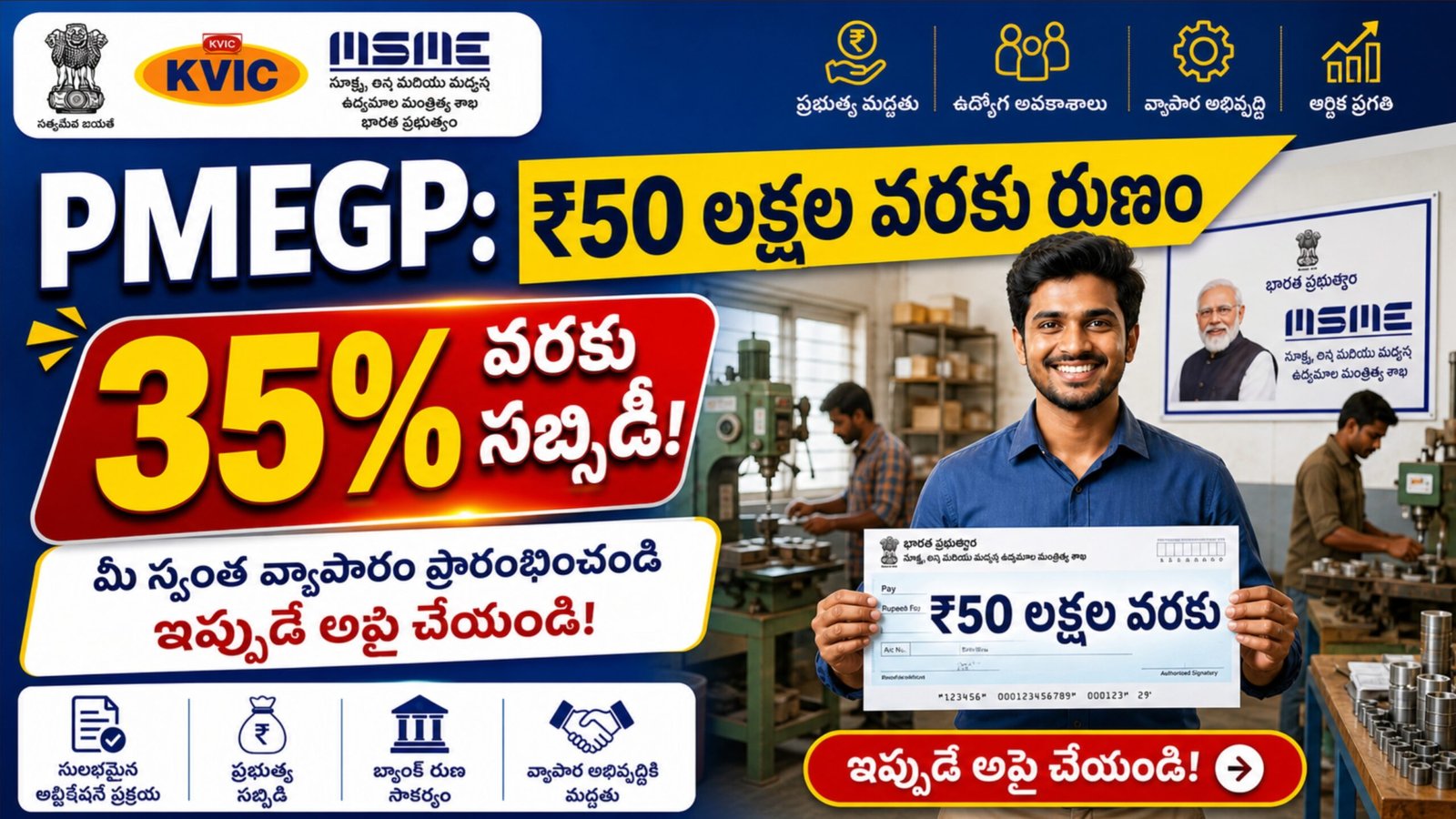
PMEGP is a credit-linked subsidy scheme, which means beneficiaries receive financial assistance in two parts: a bank loan and a government subsidy. This structure makes it easier for new entrepreneurs to manage the financial burden of setting up a business. The scheme supports both manufacturing and service sectors, with a maximum project cost of ₹50 lakh for manufacturing units and ₹20 lakh for service-based enterprises.
A key highlight of PMEGP is its subsidy support, which significantly reduces the loan repayment amount. The subsidy varies based on the applicant’s category and whether the business is located in a rural or urban area. General category applicants can receive a subsidy of 15% in urban areas and 25% in rural areas, while applicants from special categories—such as SC, ST, OBC, women, minorities, and ex-servicemen—can receive higher subsidies of 25% in urban areas and up to 35% in rural areas. This targeted approach helps promote inclusive growth and supports weaker sections of society.
To ensure commitment from the applicant, PMEGP requires a minimum personal contribution toward the project. This is set at 10% of the project cost for general category applicants and 5% for special category applicants. The remaining amount is covered by the bank loan and subsidy.
The scheme is open to a wide range of applicants. Individuals above 18 years of age can apply, as well as Self-Help Groups (SHGs), cooperative societies, and charitable trusts. However, the scheme is strictly meant for new business ventures, and existing businesses cannot claim benefits. Additionally, for larger projects—above ₹10 lakh in manufacturing or ₹5 lakh in services—applicants must have at least an 8th standard education qualification.
Applying for PMEGP is simple and digital. Interested candidates can apply through the PMEGP E-Portal by registering under the “New Unit” option. Applicants need to upload essential documents such as identity proof, PAN card, project report, and educational certificates. Once submitted, the application is verified by authorities and then forwarded to banks for approval and loan sanction.
The repayment tenure generally ranges from 3 to 7 years, giving entrepreneurs enough time to establish and grow their businesses. In many cases, banks may also offer a grace period before repayment begins.
In conclusion, PMEGP is a powerful scheme that empowers individuals to become self-reliant. By providing financial assistance, encouraging new business ideas, and supporting rural and urban development, it plays a vital role in strengthening India’s grassroots economy and promoting sustainable livelihoods.