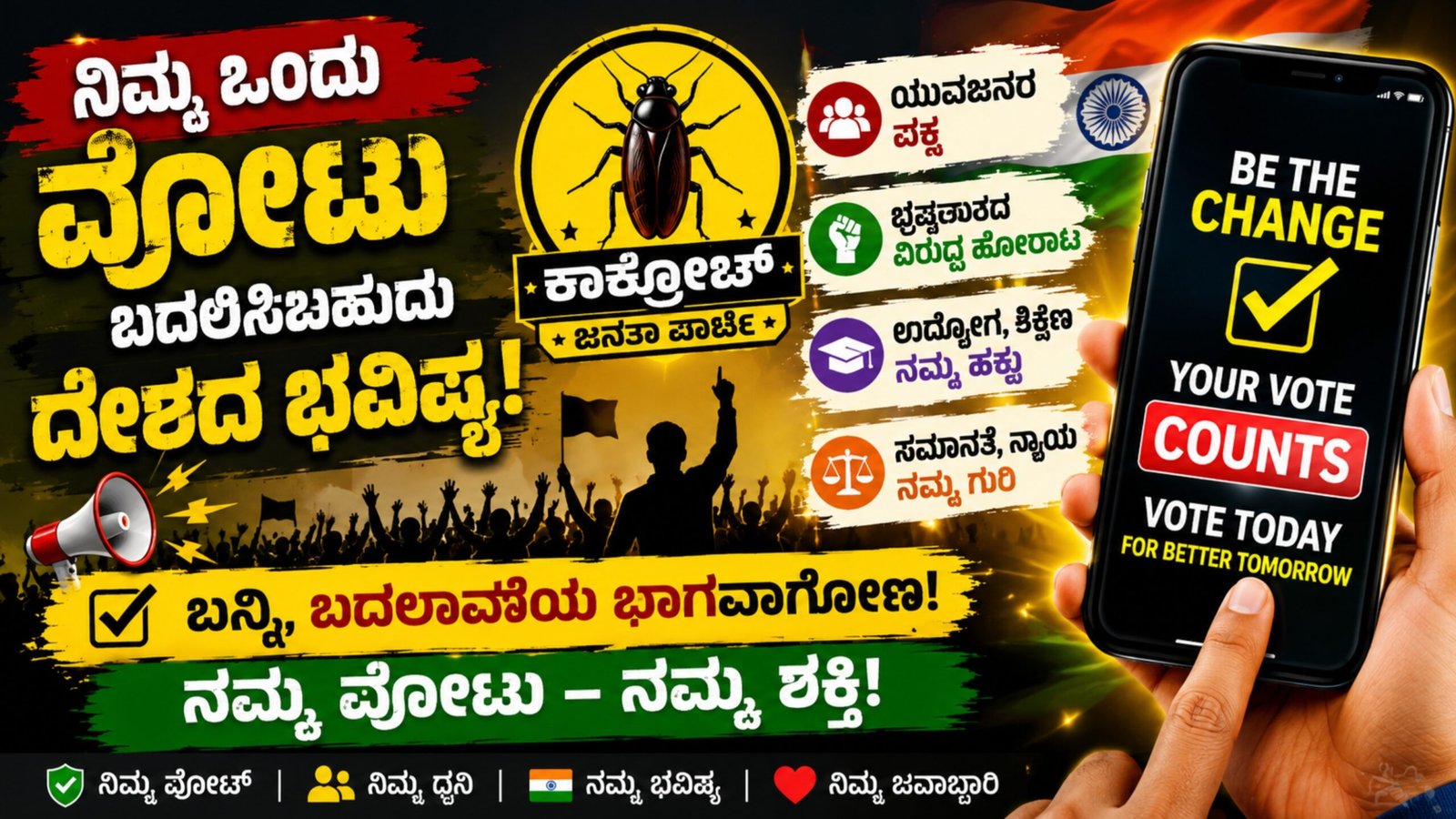
The article explores how the “Cockroach Janta Party” (CJP) transformed from a humorous internet meme into one of the most talked-about youth movements in India. The movement became popular mainly among students and unemployed youth who feel frustrated with the country’s current political and economic situation. While the party presents itself in a funny and sarcastic way, the article argues that it actually reflects serious public anger over unemployment, corruption, expensive education, and lack of opportunities for young people.
The origin of the movement is linked to controversial remarks made during a court hearing, where protesting youth were allegedly compared to “cockroaches.” Instead of rejecting the insult, social media users turned it into a symbol of resistance. Soon after, digital strategist Abhijeet Dipke launched the Cockroach Janta Party as a satirical political movement. The idea behind the name was simple: cockroaches are survivors. No matter how difficult the situation becomes, they continue to exist. Supporters started using the symbol to represent ordinary citizens who feel ignored by powerful leaders but still continue fighting for their future.
The article highlights how quickly the movement spread online. Through Instagram reels, memes, short videos, parody speeches, and sarcastic campaign slogans, the CJP attracted millions of followers within days. Young people especially connected with the movement because its content spoke directly about their everyday struggles — unemployment after graduation, competitive exam paper leaks, rising prices, lack of stable jobs, and political promises that never seem to improve real life. Unlike traditional political parties, CJP used humor and internet culture to communicate, which made it more relatable to Gen Z audiences.
Another important point discussed in the article is that the movement is not only about comedy. Beneath the jokes, there is a strong criticism of the political system. CJP supporters argue that mainstream parties focus more on religion, publicity, and elections than solving youth problems. The movement’s online campaigns often question corruption, favoritism, media influence, and the failure to create enough jobs for educated young people. Because of this, many people began seeing the party as a form of digital protest rather than just entertainment.
The article also mentions the controversies surrounding the movement. Some critics believe the party is simply a temporary internet trend that will disappear after a few weeks. Others accuse it of having hidden political motives because of the founder’s previous involvement in political communication work. There were also debates about whether social media satire can actually create meaningful political change or if it only encourages online activism without real-world action.
One of the biggest controversies happened when the party’s X (Twitter) account was reportedly restricted in India. Supporters claimed this was censorship and proof that authorities were uncomfortable with criticism and satire. Several public figures defended the movement’s right to free expression, arguing that humor and political criticism are important parts of democracy.
Overall, the article presents the Cockroach Janta Party as a symbol of modern youth frustration in India. Even though it started as a meme, it became a voice for millions of young people who feel disappointed with traditional politics. The movement shows how social media can turn satire into a powerful tool for protest and political discussion. Whether CJP becomes a real political force or remains an online rebellion, it has already succeeded in capturing the attention of India’s younger generation and starting conversations about the problems they face every day.