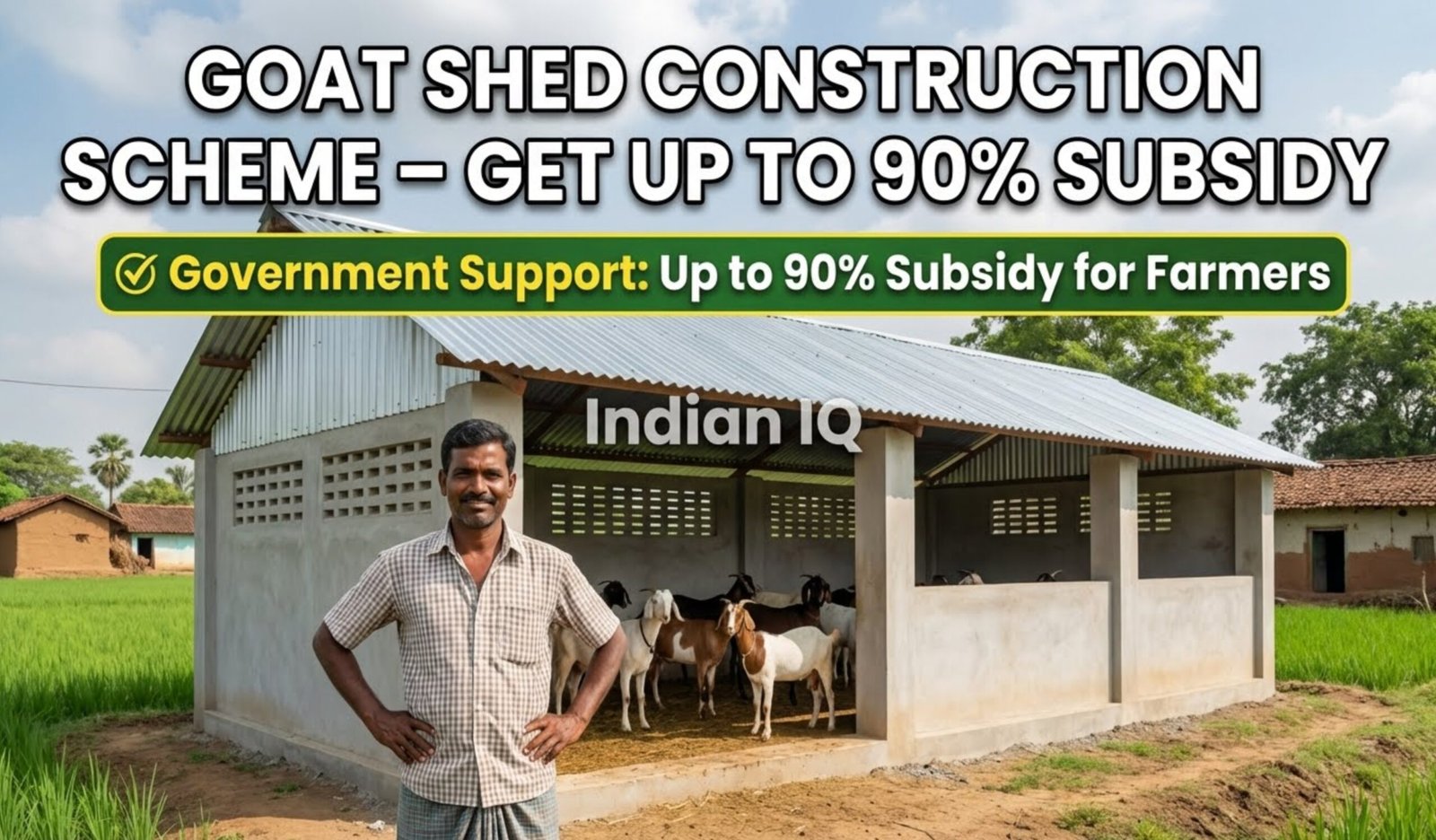
Goat farming is one of the fastest-growing livestock activities in India, especially among small and marginal farmers, landless laborers, women, and rural youth. Goats require relatively low investment, adapt well to different climatic conditions, and provide regular income through meat, milk, manure, and breeding. To promote scientific goat rearing and improve farmers’ income, the Government of India and State Governments provide financial assistance for goat shed construction, with subsidies ranging from 50% to 90% under various livestock development schemes.
What Is the Goat Shed Construction Scheme?
The Goat Shed Construction Scheme is a government-supported subsidy program that helps farmers build a proper, hygienic, and scientific goat shed. The main aim is to reduce disease, improve growth rate, minimize mortality, and increase overall productivity. A well-designed goat shed protects animals from extreme heat, cold, rain, and predators, and also makes feeding and waste management easier.
This scheme is generally implemented through:
- National Livestock Mission (NLM)
- State Animal Husbandry Departments
- Tribal development and rural livelihood missions
- Scheduled Caste / Scheduled Tribe (SC/ST) welfare schemes
- Women and Self-Help Group (SHG) programs
Subsidy Pattern: Up to 90% Support
The subsidy percentage depends on the farmer’s category and the state-specific guidelines.
General category farmers
- Subsidy: 50% to 60%
- Remaining amount to be borne by the farmer or through a bank loan
SC/ST farmers, women farmers, and SHGs
- Subsidy: 75% to 90%
- Very low personal contribution required
Tribal and backward region farmers
- Often eligible for maximum subsidy (up to 90%)
The subsidy is usually credited directly to the farmer’s bank account after verification and completion of the shed.
Why Goat Shed Construction Is Important
Many traditional farmers rear goats in open spaces or temporary shelters, which increases the risk of disease, theft, and mortality. A scientific goat shed offers several advantages:
- Protects goats from rain, heat, cold, and wild animals
- Reduces disease outbreaks and veterinary costs
- Improves weight gain and milk yield
- Enables better waste collection and manure use
- Makes management easier for large herds
A proper shed directly increases profitability and sustainability of goat farming.
Design and Size of Goat Shed
The government generally recommends raised platform sheds, especially in humid and rainy regions.
Key features of a standard goat shed:
- Raised floor (3–4 feet above ground)
- Wooden or bamboo slatted flooring for drainage
- Proper ventilation and natural light
- Sloping roof made of tiles, GI sheets, or thatch
- Separate sections for kids, pregnant does, and sick animals
Space requirement (approximate):
- Adult goat: 10–12 sq. ft.
- Kid goat: 5–6 sq. ft.
The exact design and size depend on the number of goats and local climatic conditions.
Cost of Goat Shed Construction
The cost varies based on material, location, and herd size.
Approximate cost estimates:
- Small shed (10–15 goats): ₹50,000 – ₹80,000
- Medium shed (25–30 goats): ₹1.2 lakh – ₹2 lakh
- Large shed (50+ goats): ₹3 lakh and above
With a 75–90% subsidy, farmers may need to contribute only ₹10,000 to ₹40,000, depending on the project size.
Eligibility Criteria
While eligibility rules vary by state, common requirements include:
- Applicant must be an Indian citizen
- Must be involved or willing to start goat farming
- Minimum land ownership or lease arrangement (varies by state)
- Priority given to SC/ST, women, SHGs, and rural youth
- Applicant should not have availed similar subsidy earlier (in most cases)
Required Documents
To apply for the goat shed subsidy, farmers generally need:
- Aadhaar card
- Land ownership or lease document
- Bank account details (linked with Aadhaar)
- Caste certificate (if applicable)
- Income certificate
- Goat farming project report
- Passport-size photographs
Some states may also ask for a no-objection certificate from the local panchayat.
Application Process
The application process is mostly offline, though some states also provide online portals.
Step-by-step process:
- Visit the Animal Husbandry Department or Veterinary Hospital
- Collect and submit the application form
- Prepare a simple project report with shed design and cost
- Department officials inspect the site
- Approval and sanction of subsidy
- Construct the shed as per guidelines
- Final inspection and release of subsidy to bank account
Benefits to Farmers
The Goat Shed Construction Scheme offers multiple long-term benefits:
- Reduces initial investment burden
- Encourages scientific livestock management
- Increases income and employment in rural areas
- Supports women empowerment and self-employment
- Strengthens the goat meat and dairy value chain
Application Link
| Karnataka | Apply Now |
| Telangana | |
| Andrapradesh | Apply Now |
The Goat Shed Construction Scheme in India is a highly beneficial initiative for farmers looking to start or expand goat farming with minimal risk. With subsidies going up to 90%, especially for SC/ST farmers, women, and SHGs, this scheme significantly lowers the cost of infrastructure and promotes sustainable livestock development. Farmers interested in goat rearing should contact their nearest Animal Husbandry Department to understand state-specific guidelines and make the most of this opportunity to build a profitable goat farming enterprise.