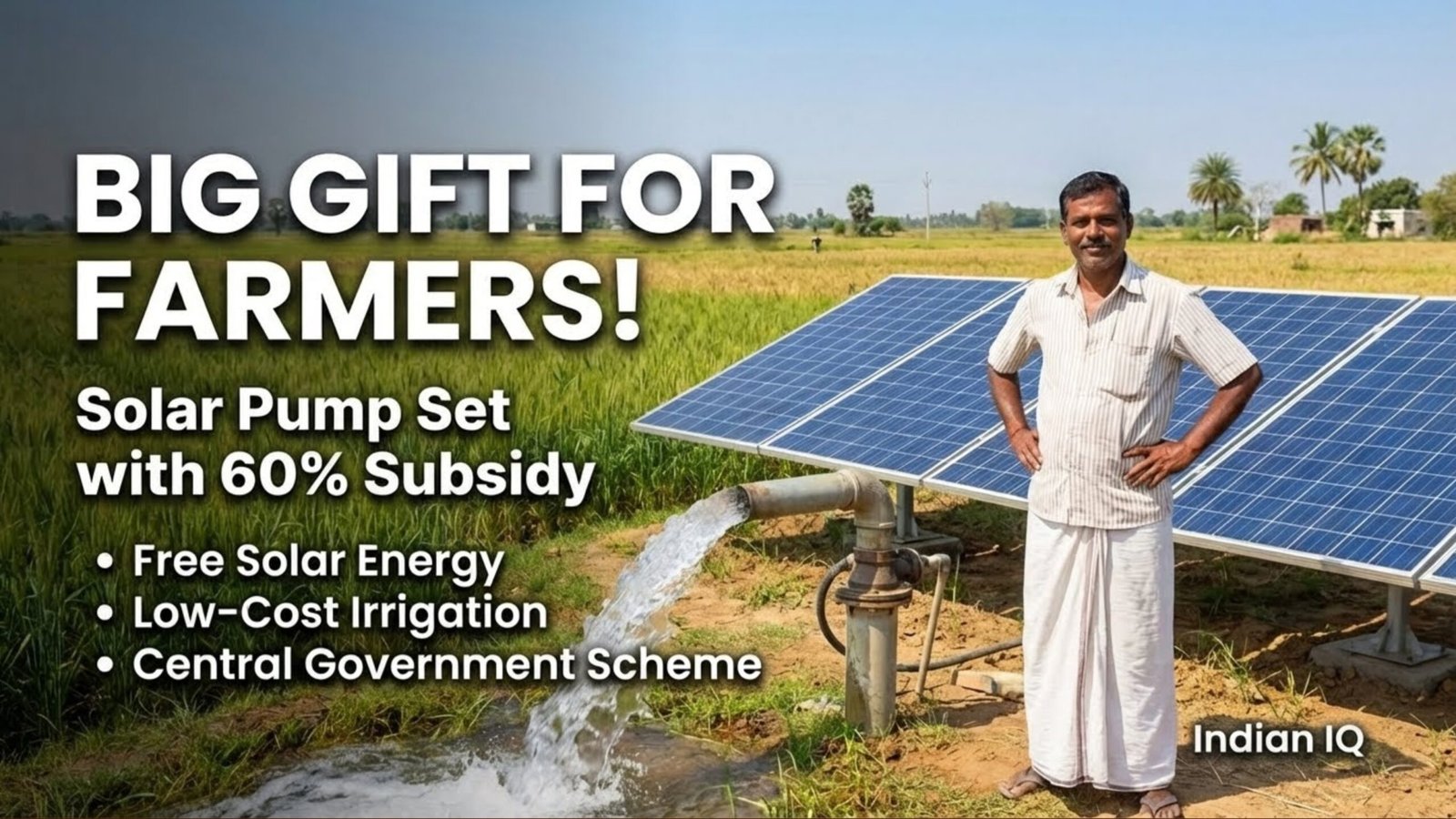
To support farmers, reduce irrigation costs, and promote renewable energy, the Central Government of India has introduced a major initiative that provides solar-powered pump sets with up to 60% subsidy. This scheme is a game-changer for farmers who depend heavily on diesel or electricity for irrigation. With rising fuel prices, power shortages, and climate challenges, solar pump sets offer a long-term, cost-effective, and eco-friendly solution.
What Is a Solar Pump Set?
A solar pump set is an irrigation system powered by solar energy instead of electricity or diesel. It uses solar panels to generate electricity, which then runs a water pump to draw groundwater or surface water for irrigation.
Solar pump sets are mainly of two types:
- Surface solar pumps – used for open wells, ponds, and canals
- Submersible solar pumps – used for borewells and deep groundwater sources
These pumps can be used for crops, horticulture, drip irrigation, and even drinking water supply for livestock.
Name of the Scheme
The subsidy is mainly provided under the PM-KUSUM Scheme (Pradhan Mantri Kisan Urja Suraksha evam Utthaan Mahabhiyan). This is one of the most ambitious renewable energy schemes for farmers in India.
Key Objective of the Scheme
The government launched this scheme with several important goals:
- Reduce farmers’ dependence on diesel and grid electricity
- Lower irrigation costs and improve farm income
- Promote clean and renewable solar energy
- Reduce carbon emissions and environmental pollution
- Ensure reliable power supply in rural and remote areas
- Encourage sustainable and climate-resilient agriculture
Subsidy Details: How Farmers Get 60% Benefit
Under this scheme, the total cost of the solar pump set is divided into three parts:
- Central Government Subsidy: 30%
- State Government Subsidy: 30%
- Farmer’s Contribution: Only 40%
In some states, additional support or bank loans are provided, reducing the farmer’s immediate financial burden even further.
This means if a solar pump system costs ₹5 lakh, the farmer may need to pay only around ₹2 lakh, while the remaining ₹3 lakh is covered by government subsidies.
Types of Solar Pumps Covered
The scheme supports different pump capacities to suit various farming needs:
- 1 HP to 2 HP – Small and marginal farmers
- 3 HP to 5 HP – Medium farmers
- Up to 10 HP – Large landholders and community irrigation
Both AC and DC solar pump systems are covered, depending on state guidelines and groundwater conditions.
Eligibility Criteria for Farmers
To apply for the solar pump subsidy, farmers must meet certain conditions:
- Must be an Indian citizen
- Should be an active farmer with cultivable land
- Ownership or lease documents of agricultural land are required
- Borewell or water source should be available
- Preference may be given to:
- Small and marginal farmers
- SC/ST farmers
- Farmers in drought-prone or remote areas
Farmers who already receive free or highly subsidized electricity may have different eligibility rules depending on the state.
Documents Required
Farmers typically need the following documents while applying:
- Aadhaar card
- Land ownership or RTC / Patta documents
- Bank passbook or account details
- Passport-size photographs
- Borewell permission or water source certificate
- Caste certificate (if applicable)
Exact document requirements may vary slightly from state to state.
Application Process
The application process is mostly online and handled by state nodal agencies:
- Visit the official PM-KUSUM or state renewable energy portal
- Register using Aadhaar and mobile number
- Fill in farmer and land details
- Select pump capacity and type
- Upload required documents
- Pay the farmer’s contribution amount
- Application verification by authorities
- Installation by empanelled vendors
After verification, the solar pump is installed at the farmer’s field, usually within a few weeks to months depending on demand.
Major Benefits of Solar Pump Sets
1. Huge Cost Savings
Once installed, solar pumps run on free sunlight. Farmers save thousands of rupees every year on diesel or electricity bills.
2. Reliable Irrigation
Solar pumps provide daytime irrigation without power cuts, especially useful in rural areas with unreliable electricity supply.
3. Environment-Friendly
Solar energy produces zero pollution and helps reduce carbon emissions and groundwater over-extraction when used responsibly.
4. Low Maintenance
Solar pump systems have fewer moving parts and require minimal maintenance compared to diesel engines.
5. Increased Farm Productivity
With assured irrigation, farmers can grow multiple crops, improve yields, and shift to cash crops or horticulture.
Challenges and Limitations
Despite its benefits, the scheme has some challenges:
- High initial cost even after subsidy for some farmers
- Delays in approval and installation in certain states
- Limited awareness among small farmers
- Groundwater sustainability concerns
To address these issues, the government is promoting micro-irrigation systems like drip and sprinkler irrigation along with solar pumps.
Impact on Farmers and Rural Economy
The solar pump subsidy scheme has already benefited lakhs of farmers across India. It has helped reduce fuel imports, strengthened rural energy security, and boosted farmers’ confidence in renewable technologies.
In the long run, this initiative supports:
- Atmanirbhar Bharat (Self-Reliant India)
- Green energy transition
- Climate-smart agriculture
- Doubling farmers’ income
Apply Now
The 60% subsidy on solar pump sets is truly a “bumper gift” from the Central Government for Indian farmers. By combining financial support with clean energy, the scheme offers a sustainable solution to irrigation challenges. While there are implementation hurdles, the overall impact is overwhelmingly positive.
For farmers looking to reduce costs, ensure reliable irrigation, and adopt future-ready farming practices, solar pump sets under the PM-KUSUM scheme are a powerful opportunity that should not be missed.