Introduction: Why PM-WANI Matters
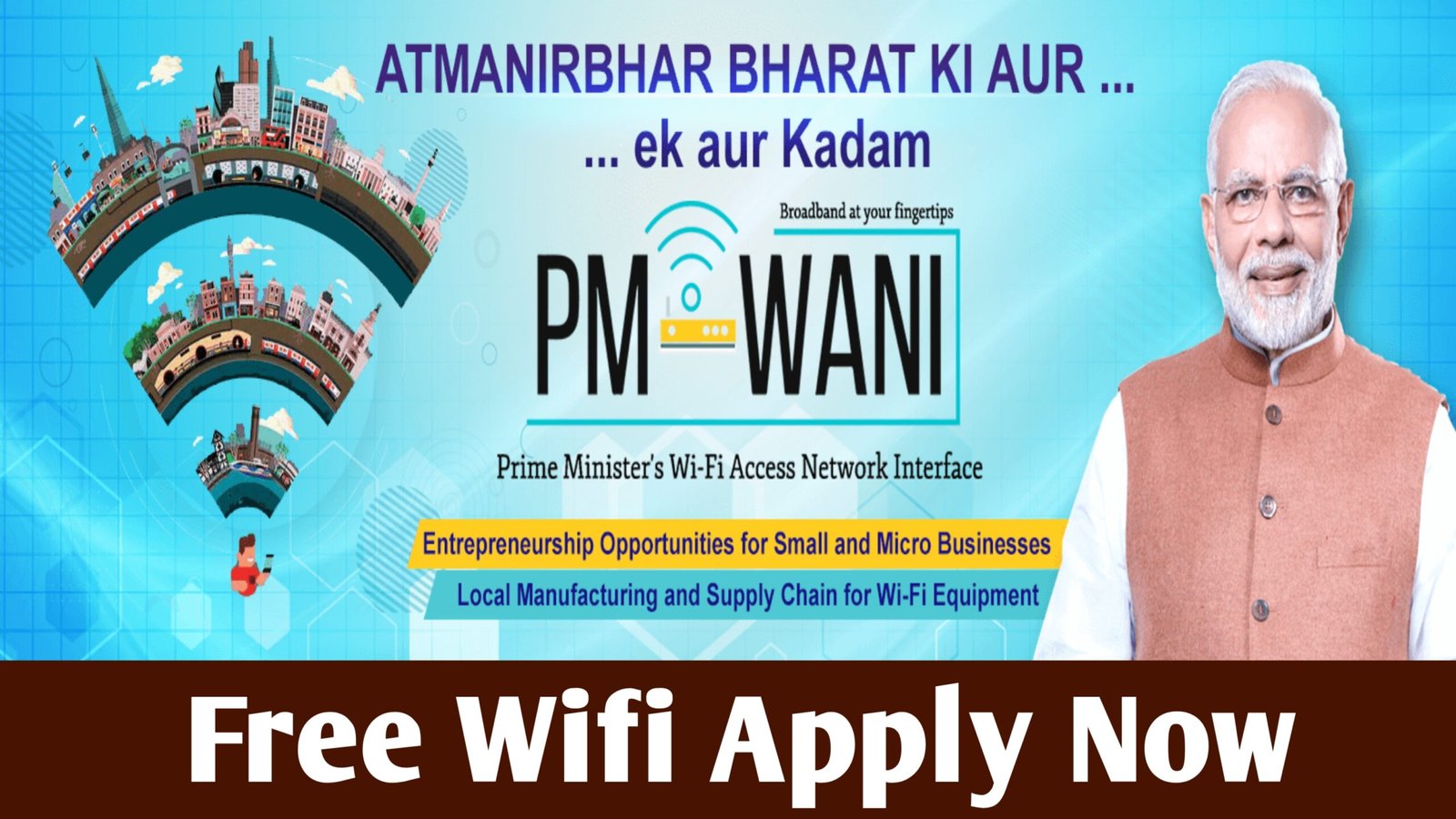
In the digital age, internet connectivity is no longer a luxury — it’s a necessity. Yet, access to reliable and affordable broadband remains a challenge in many parts of India, especially in rural and semi-urban areas. Recognizing this, the Indian government launched the PM-WANI (Prime Minister Wi-Fi Access Network Interface) scheme to dramatically expand public Wi-Fi availability across the country.
Approved by the Union Cabinet in December 2020, PM-WANI aims to create a massive network of public Wi-Fi hotspots. These hotspots are meant to be provided by local small businesses, shop owners, and entrepreneurs — not by big telcos alone. This decentralized model is designed to boost digital inclusion, internet penetration, and economic opportunity for both users and hotspot providers. (The Indian Express)
Prime Minister Narendra Modi has called it a “historic” initiative that will revolutionize the tech world and significantly improve Wi-Fi availability across India. (ETGovernment.com)
The Vision Behind PM-WANI
To understand PM-WANI, you need to know its underlying goals and policy anchors:
- Bridging the digital divide: By enabling low-cost, local-level Wi-Fi access, PM-WANI seeks to bring internet connectivity to underserved and remote communities. (India Today)
- Promoting entrepreneurship: Any local shop, small business, or individual can become a Public Data Office (PDO), earning by providing Wi-Fi services. (pmwani.uiapl.com)
- Ease of Doing Business: The scheme removes heavy regulatory burden: no license fees for PDOs, and minimal registration. (The Indian Express)
- Digital India mission: It supports national goals of digital connectivity, inclusion, and economic empowerment. (ETGovernment.com)
- Complement to broadband access: PM-WANI is not intended to compete with fiber or mobile broadband — rather, it augments them, especially in the “last mile.”
Key Components of the PM-WANI Ecosystem
PM-WANI is not just a “free Wi-Fi” scheme — it sets up a structured ecosystem with multiple roles. The main components are:
- Public Data Office (PDO)
- These are the local Wi-Fi hotspots: small shops, common service centers, or even homes. (The Indian Express)
- PDOs procure broadband from an ISP or telecom provider and then share it via Wi-Fi to users. (pmwani.uiapl.com)
- They maintain, operate, and manage the hotspot.
- Public Data Office Aggregator (PDOA)
- PDOAs aggregate many PDOs. (Insights IAS)
- Their functions include authorization (verifying and onboarding PDOs) and accounting (managing usage, payments). (Insights IAS)
- They act as intermediaries between PDOs and users.
- App Provider
- App Providers build and maintain the mobile/web applications that users will use to discover WANI-compliant hotspots. (Insights IAS)
- Through these apps, users register, authenticate, and select a PDO to connect to. (The Indian Express)
- These apps will also display tariff plans for different PDOs.
- Central Registry
- A digital central registry maintains records of all PDOs, PDOAs, and App Providers. (registrationkraft.com)
- This registry is maintained by C-DoT (Centre for Development of Telematics), ensuring transparency and oversight. (Insights IAS)
How PM-WANI Works: Step-by-Step
Here is a breakdown of how the system operates in practice — from a shop owner turning into a PDO to a user connecting to Wi-Fi.
- Becoming a PDO
- A small business or individual (shop, café, local store, etc.) purchases a Wi-Fi access point (router) that is PM-WANI compliant. (pmwani.uiapl.com)
- They also need a broadband backhaul connection — i.e., they subscribe to a regular ISP to get internet at their location.
- Registration
- The aspiring PDO registers with a PDOA. The registration process is simple and there is no license fee for PDOs. (Jagranjosh.com)
- PDOA then authorizes the PDO and includes it in its network of hotspots.
- User onboarding via App
- A user downloads a PM-WANI–compatible app from an App Provider. (Insights IAS)
- The app displays a list/map of nearby WANI hotspots (PDOs).
- The user registers (e-KYC(Authentication) is done) and then selects a PDO to connect to. (The Indian Express)
- Tariff plans (per hour / per GB / daily) are shown, set by the PDOA or PDO. (Insights IAS)
- Making a Payment
- After selecting a plan, the user makes payment through the app (digital payment). (registrationkraft.com)
- The payment goes to the PDOA, which then credits the PDO’s share. The PDOA handles accounting, billing, and authentication.
- Connection
- Once payment is confirmed, the user is authenticated by the PDOA.
- The PDOA grants access to the PDO’s Wi-Fi hotspot, and the user can connect to the Wi-Fi. (Insights IAS)
This model decentralizes Wi-Fi provision, democratizes access to data, and enables local entrepreneurs to monetize their internet bandwidth.
Major Benefits and Impact
PM-WANI offers multiple benefits, both for users and for those who become PDOs. Let’s dive into them:
A. For Users (Internet Consumers)
- Affordable Connectivity: By leveraging local Wi-Fi, users can access internet at lower cost than many mobile data plans. (Insights IAS)
- No Need for SIM: Users do not need a SIM card — the app-based authentication (eKYC) is sufficient. (registrationkraft.com)
- Wide Coverage: With small local shops, CSCs, and public places becoming PDOs, Wi-Fi becomes accessible in many more places, including rural areas. (pmwani.uiapl.com)
- Interoperability: User doesn’t need a different app for every hotspot; a single PM-WANI app can discover and connect to multiple PDOs. (The Indian Express)
- Digital Inclusion: It helps bring more people into the digital economy, enabling access to e-learning, e-commerce, digital governance, and more.
B. For PDOs (Local Entrepreneurs / Shop Owners)
- New Revenue Source: PDOs can monetize their idle bandwidth by selling Wi-Fi access to users. (shinepmwani.com)
- No License Cost: There’s no licensing fee for PDOs, making it easier for small players to participate. (The Indian Express)
- Low Regulatory Hassle: They’re not heavily regulated; registration is easy. (PM WANI)
- Business Growth: Small shops can attract more footfall (e.g., customers using Wi-Fi) and build micro-business around connectivity.
C. For the Nation / Economy
- Digital Infrastructure Strengthening: PM-WANI accelerates the building of a public Wi-Fi infrastructure, aligning with the National Digital Communications Policy. (Insights IAS)
- Employment Generation: New roles emerge – PDO management, hotspot maintenance, aggregator functions. (ETGovernment.com)
- Boost to GDP: More internet usage, more entrepreneurship, and more digital commerce potentially contribute to economic growth. (ETGovernment.com)
- Bridging the Connectivity Gap: Particularly in underserved areas, public Wi-Fi can narrow the digital divide.
Regulatory & Policy Design: What Makes PM-WANI Unique
PM-WANI is built on a smart, light-touch regulatory architecture to encourage participation:
- No Licensing for PDOs
- Unlike traditional telecom operations, PDOs do not need a license to provide public Wi-Fi. (The Indian Express)
- Simple Registration
- PDOAs and App Providers do need to be registered with the Department of Telecom (DoT), but the registration is free. (The Indian Express)
- The process must be completed within 7 working days of application; if DoT doesn’t respond in that time, registration is deemed approved. (The Indian Express)
- Central Registry
- Maintained by C-DoT, this registry ensures transparency: it holds the list of all PDOs, PDOAs, and apps. (registrationkraft.com)
- Helps in user authentication, accountability, and auditing.
- Tariff Regulation
- According to TRAI proposals, there are tariff caps for PM-WANI usage to maintain affordability.
- If PDOs were forced to pay exorbitant bandwidth prices, the model wouldn’t work. Regulators are thus intervening to make sure the cost structure is sustainable.
- Complementary Model
- PM-WANI is not designed to replace mobile or fixed broadband. Instead, it is complementary — it helps reach last-mile connectivity.
- The growth of public Wi-Fi could stimulate demand for more broadband overall, creating a virtuous cycle.
Real-World Implementation: Who’s Doing It & How
A number of players are already operational under the PM-WANI framework. Here’s how it’s unfolding on the ground:
- BharatWANI: One of the Public Data Office Aggregators (PDOAs) participating in the scheme. (BharatWANI WiFi)
- It supports PDOs by providing devices and infrastructure. (BharatWANI WiFi)
- Users can download BharatWANI’s app to find hotspots, recharge plans, pay for usage, and connect. (BharatWANI WiFi)
- They advertise “zero installation cost” for hotspot providers, which lowers the barrier to entry. (BharatWANI WiFi)
- Shine Broadband / Shine PM WANI: Another PDOA active in the ecosystem. (shinepmwani.com)
- It encourages small establishments (shops, hotels, cafes) to become PDOs by sharing their Wi-Fi. (shinepmwani.com)
- Offers flexible tariff plans and share of revenue to hotspot providers. (shinepmwani.com)
- Claims “no KYC of users required” at the hotspot level because authentication is handled by the central system. (shinepmwani.com)
- Regulatory Design:
- According to the Department of Telecom and TRAI, the public Wi-Fi rollout is aligned with the National Digital Communications Policy of 2018. (Insights IAS)
- TRAI’s recent draft consultation papers discuss tariff interventions to ensure economically viable public Wi-Fi by capping rates, making it sustainable for PDOs.
- The telecom regulators also expect the PM-WANI ecosystem to generate demand for more fixed broadband and mobile broadband in underserved areas.
Challenges & Criticisms
While PM-WANI has strong potential, there are also several real-world challenges and criticisms:
- Bandwidth Cost for PDOs
- Some PDOs complain that the cost of backhaul (broadband purchased to feed the hotspot) is too high. TRAI’s own analysis suggests that in some areas, PDOs struggle to make the economics work.
- If bandwidth is expensive, PDOs may not earn enough to justify their investments.
- Sustainability & Business Model
- Though the “no license, no fee” model is attractive, the long-term viability depends on user uptake, regular payment, and active usage.
- If user adoption is low, PDOs may drop off.
- Some have questioned whether very low-cost Wi-Fi will cannibalize mobile data or fixed broadband rather than complement them. (Though the scheme is designed to be complementary.)
- Security & Privacy Concerns
- Public Wi-Fi is always more vulnerable to misuse, hacking, and privacy risks. >
From Reddit: “Open public Wi-Fis have been known to be vulnerable to hacks … in absence of robust data protection legislation … possibility of rogue networks … users’ data may be at risk.” (Reddit)
- Ensuring that PDOAs and PDOs implement strong encryption, secure authentication, and logging is critical.
- Public Wi-Fi is always more vulnerable to misuse, hacking, and privacy risks. >
- Infrastructure and Maintenance
- Not all PDOs may have the technical capability to maintain high-quality Wi-Fi access points.
- Power outages, rundown infrastructure, or poor broadband backhaul could hamper the user experience.
- Adoption & Awareness
- Users may not be aware of PM-WANI, or may not trust public Wi-Fi.
- App adoption, onboarding, and charging users requires outreach and education.
- Regulatory Enforcement
- Ensuring that every PDO, PDOA, and app provider follows the rules (tariffs, security, accounting) requires strong oversight.
- If ISPs (internet service providers) overcharge PDOs or discriminate, it undermines the model. TRAI’s reports suggest such practices in some cases.
Success Stories & Early Impact
Though PM-WANI is still growing, there are early signs of its impact:
- Digital Inclusion: With shops, cafés, and local businesses becoming PDOs, public Wi-Fi is becoming much more accessible in localities that previously lacked broadband.
- Local Entrepreneurs: Small shop owners now view their space not just as a shop, but also a digital node. It offers a supplemental income stream.
- Cost Savings for Users: Instead of relying solely on often-expensive mobile data, users can now access public Wi-Fi for specific needs (e.g., studying, content consumption).
- Economic Multiplier: As public internet use grows, demand for other digital services (e-commerce, online education, digital payments) may rise, which could accelerate digitization in under-connected areas.
Future Prospects and Scale-Up
PM-WANI is still in its early-to-mid rollout phase, but the long-term potential is enormous:
- Target of Tens of Millions of Hotspots
- According to TRAI and policy documents, India aims to scale to tens of millions of PM-WANI hotspots in the coming years.
- This would be transformative in covering the “last mile” of connectivity.
- Synergy with BharatNet
- PM-WANI hotspots can leverage BharatNet infrastructure (optical fibre backbone) in rural areas, for stable and high-speed backhaul. (PM WANI)
- This synergy means that public Wi-Fi could become a powerful extension of the national fiber network.
- Economic Growth & Digital Entrepreneurship
- As more small businesses become PDOs, there will be a grassroots-level digital entrepreneurship wave.
- Revenue-sharing models could improve, making Wi-Fi provision an attractive business.
- Policy Evolution
- Regulators like TRAI may continue to refine tariff rules to make PM-WANI more viable for PDOs and affordable for users.
- There may be stricter security norms, data privacy protections, and quality-of-service (QoS) standards as the scheme scales.
- Integration with Smart Cities
- In urban smart city projects, PM-WANI hotspots can become part of city-wide digital infrastructure — in public transport hubs, parks, markets, and more.
- Potential for Innovation
- App Providers could build more intelligent features: automatic hotspot discovery, user ratings, data plans tailored to time-of-day usage, student/off-peak pricing, etc.
- Aggregators (PDOAs) may develop sophisticated billing, data analytics, and bandwidth optimization models.
How to Use PM-WANI as a User (Practical Guide)
If you are a user wanting to access PM-WANI Wi-Fi, here’s a practical guide:
- Download a PM-WANI App
- Choose an app from a registered App Provider. These are available on Android / iOS. (Insights IAS)
- Register / Authenticate
- Complete eKYC (some basic identity verification) using the app — this is required to access Wi-Fi. (India Today)
- Find Nearby Hotspots
- Use the app’s map / list to find nearby WANI hotspots (PDOs).
- Select Plan
- Browse tariff plans (hourly, daily, or data-based) offered by the PDOs. (Insights IAS)
- Make Payment
- Pay digitally through the app. The transaction goes to the aggregator who distributes revenue accordingly. (Insights IAS)
- Connect & Use
- After payment and authentication, connect to the hotspot SSID as instructed in the app.
- Manage Usage
- Monitor usage, data remaining, and top-up if needed using the app.
How to Become a PDO (Practical Guide)
If you’re a shop owner or small entrepreneur and want to become a PDO, here’s how:
- Evaluate Feasibility
- Check if you already have a broadband connection.
- Estimate how many users might use your Wi-Fi hotspot.
- Evaluate the cost of buying a WANI-compliant access point (router).
- Choose a PDOA
- Research PDOAs in your area (e.g., BharatWANI, Shine Broadband). (BharatWANI WiFi)
- Register with them to become a PDO.
- Register as PDO
- Provide details: business address, broadband source, basic documents.
- Your PDOA helps with onboarding, authentication system, and app integration.
- Setup Hotspot
- Install a WANI-compliant router/AP.
- Configure it as directed by the PDOA.
- Link the hotspot with your broadband and the aggregator’s system.
- Launch and Monetize
- Choose tariff plans in consultation with your PDOA.
- Make your hotspot publicly visible via the associated app.
- Monitor usage, revenue, and user feedback.
- Maintain & Support
- Keep your hardware running with minimal downtime.
- Provide basic user help if needed (e.g., login issues).
- Work with your PDOA to resolve any technical billing or accounting issues.
Risks to Watch & Mitigation Strategies
Here are some risks involved in PM-WANI — and ways in which they can be mitigated:
- Low Adoption
- Risk: If users do not adopt the service, PDOs will struggle.
- Solution: App Providers and PDOAs should run awareness campaigns, demo hotspots, and offer introductory plans.
- Financial Loss for PDOs
- Risk: High cost of internet backhaul could eat into profits.
- Solution: Negotiate with ISPs for favorable rates; explore shared bandwidth or community models.
- Security Vulnerabilities
- Risk: Public Wi-Fi may be vulnerable to misuse, hacking, or data leakage.
- Solution: Enforce strong encryption, use secure authentication, and monitor usage. Regulators should define and enforce data privacy norms.
- Poor Quality of Service (QoS)
- Risk: Overloaded hotspots may provide very low quality or slow speeds.
- Solution: PDOs should invest in good hardware and scale them based on demand; PDOAs can help with traffic management.
- Regulatory Non-Compliance
- Risk: Some PDOs or PDOAs may not follow tariff or accounting rules.
- Solution: Strict audits, compliance checks by central registry / DoT, and a feedback mechanism from users.
PM-WANI & Broader Digital India Goals
PM-WANI is not just about providing Wi-Fi — it’s part of a bigger vision for India’s digital future:
- Digital Inclusion: More people connected means greater participation in online education, telemedicine, e-governance, and e-commerce.
- Smart Cities: Hotspots can support smart city services (IoT, public information systems, transport).
- Digital Economy: As more users come online, digital payments, cloud services, and online business models become more viable.
- Sustainable Growth: Local entrepreneurs (PDOs) earn, more data is consumed, and economic value is created from underused bandwidth.
Apply Now
The PM-WANI scheme represents a bold and innovative step in India’s digital transformation journey. By decentralizing Wi-Fi access, enabling small businesses to become internet providers, and simplifying the regulatory burden, it has the potential to reshape how Indians connect to the internet.
- It democratizes access to broadband by enabling affordable, local, public Wi-Fi.
- It fosters entrepreneurship, giving shop owners and individuals a chance to monetize their internet footprint.
- It supports national aims of digital inclusion and broadband proliferation.
- It is designed to work in harmony with mobile and fixed broadband infrastructure, not as a rival.
But like any ambitious project, PM-WANI faces real-world challenges — from cost sustainability to security concerns. Addressing these will be critical for its long-term success. With effective regulation, community engagement, and ongoing innovation, PM-WANI could truly usher in a Wi-Fi revolution in India.
In sum, PM-WANI is not just a scheme — it’s a potential game-changer in India’s public connectivity narrative. For the millions who lack reliable, affordable internet, it could be the bridge to opportunity, information, and a more digitally empowered future.